The Four Wealth Engines of Homeownership


Why Most People Misunderstand How Real Estate Really Creates Wealth
Ask someone why homeowners become wealthy, and you'll almost always hear the same answer:
"Because house prices go up."
It's a reasonable answer. But it is also incomplete. And its extremely important to answer this specially at such times like today when market confidence is very low.
After working with hundreds of buyers, sellers, and investors over the years, I've noticed something interesting. Many people focus almost exclusively on one variable—the future selling price of a home.
They watch interest rates. They watch headlines. They debate whether prices will rise or fall next year. Yet very few stop to consider how wealth is actually created while they own the property.
The value of homeownership isn't determined solely on the day you buy or the day you sell It's created quietly, month after month, through several forces working together. I like to visualize them as the Four Wealth Engines of Homeownership.
Engine #1: Market Appreciation
This is the aspect that receives almost all the attention. When home prices rise, the value of your property increases and so does your equity. It's the number that dominates headlines, fuels conversations at social gatherings, and often shapes public perception of the housing market.
But here's what many people overlook:
Appreciation is only one contributor to wealth—not the entire story.
In fact, I often hear people say,
"My house hasn't gone up much over the last couple of years, so I haven't really built any wealth."
That not necessarily true.
Wealth isn't measured only by today's market value. It's measured by how much of the property you actually own. While appreciation may slow during certain market cycles, the other wealth engines continue working quietly in the background.
This is why experienced homeowners often think differently from first-time buyers. They understand that real estate should be evaluated over years—not quarters.
History has shown that housing markets move in cycles. Some years deliver exceptional appreciation, while others are relatively flat or even negative. Trying to predict exactly when those cycles will occur is extraordinarily difficult, even for professionals.
What matters more is recognizing that appreciation is the most visible wealth engine—but not necessarily the most reliable in any given year.
That perspective changes the conversation.
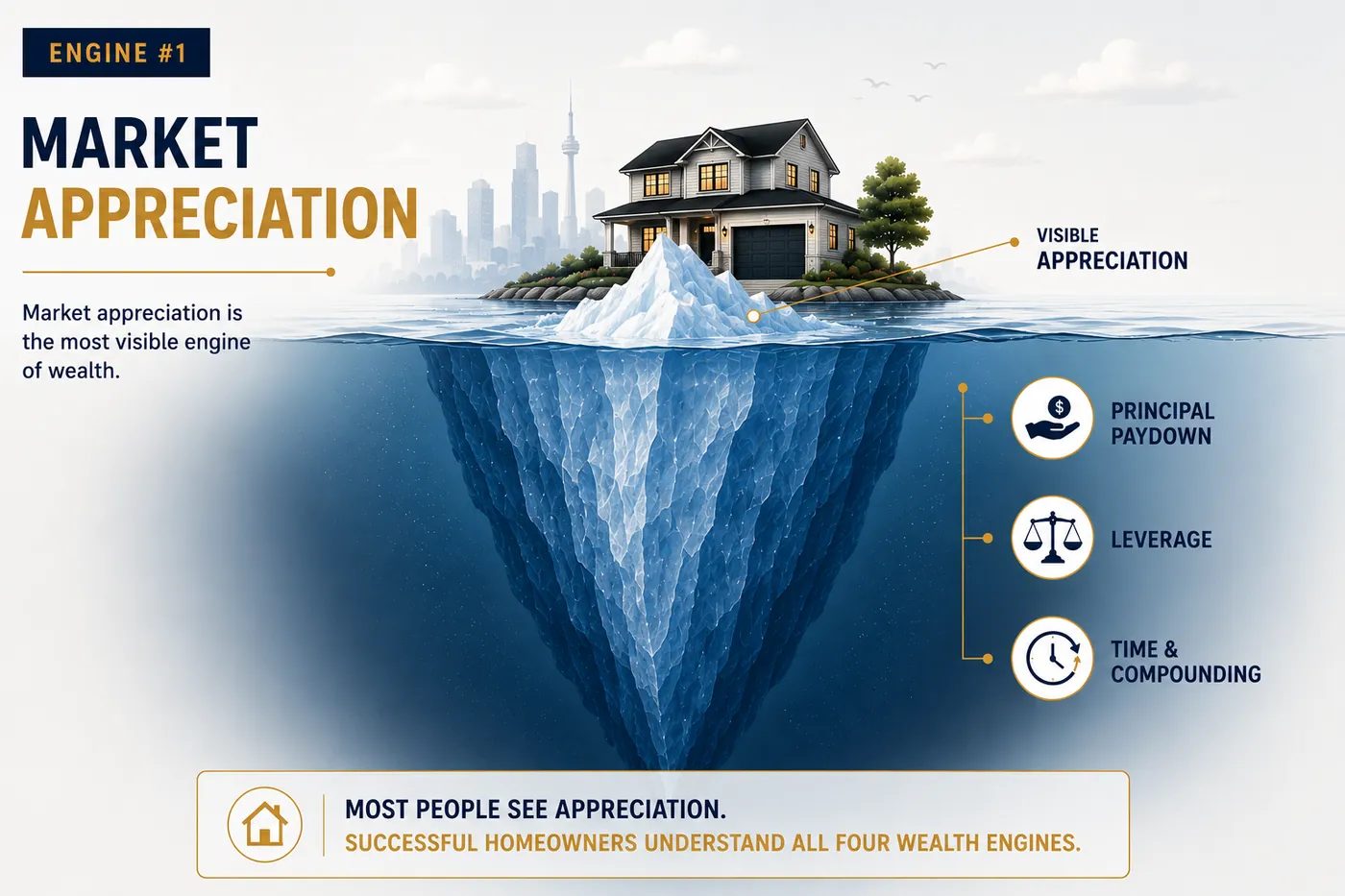
Because when appreciation eventually returns—as it has historically after previous market cycles—it credibly builds upon the equity that has already been accumulated through principal repayment, responsible leverage, and time.
Appreciation may receive the headlines. But it rarely works alone.
Engine #2: Mortgage Principal Paydown
If appreciation is the wealth engine everyone talks about, principal paydown is the one almost everyone overlooks.
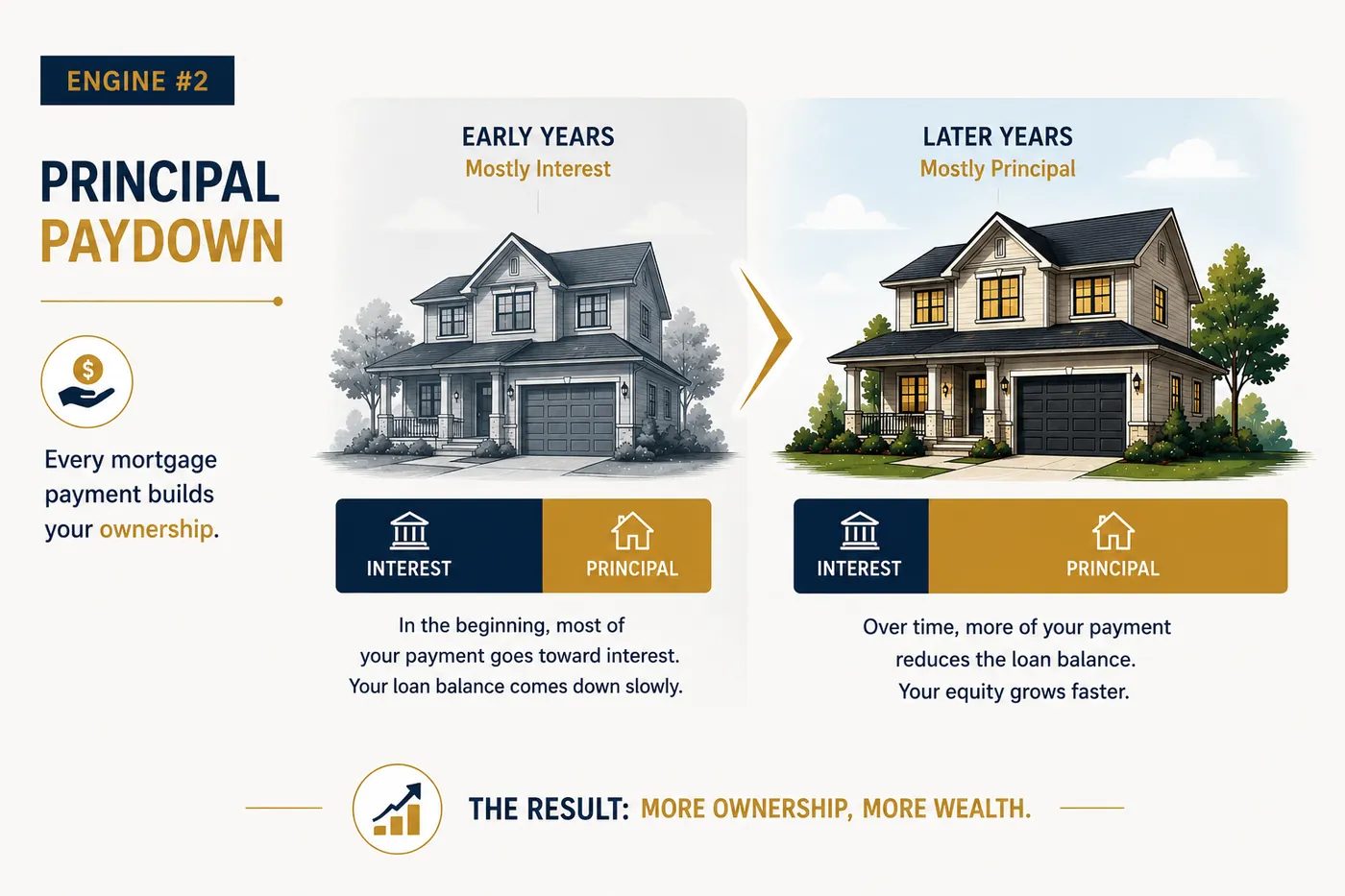
Every mortgage payment you make is divided into two parts.
One portion pays the cost of borrowing money—the interest. The other quietly purchases a larger share of your own property - the principal.
That second portion doesn't generate headlines. It is never discussed on the evening news and in our social circles. Yet it is one of the most predictable and reliable ways homeowners build wealth. Every month, your mortgage balance becomes a little smaller. Every month, your ownership becomes a little larger.
Unlike market appreciation, this doesn't depend on what the economy does, where interest rates move, or whether the housing market has a strong or weak year. It happens simply because we continue making your mortgage payments.
This is an important distinction. Many people assume that if home prices remain flat for several years, their financial position hasn't improved.
Even if your property's market value remained exactly the same, your equity would continue to grow because you owe less than you did before. You're steadily converting debt into ownership.
When you first purchase a home, the bank may own a significant portion of the asset.With every principal payment, you're gradually buying that portion back.
By the end of your mortgage, you don't simply have a house that may have appreciated—you have an asset that you own outright.
This process of principal repayment every month quietly becomes one of the largest contributors to a family's net worth. Perhaps that's one of the biggest lessons in wealth creation:
Not every form of progress is immediately visible.
A Simple Example
Imagine a family purchases an $800,000 home with a 20% down payment ($160,000) and finances the remaining $640,000 with a 25-year mortgage at a fixed interest rate of 3.5%.
Now, let's fast forward five years and assume a very conservative scenario: the home's value hasn't increased at all. It's still worth $800,000.
Many people would conclude that the family hasn't built any wealth because there has been no appreciation.
But that's not true.
Over those five years, they would have paid down approximately $87,800 of mortgage principal. That means their ownership in the property has increased by nearly $88,000, even though the market value hasn't changed.
They've quietly converted debt into equity—simply by making their regular mortgage payments. And that's before considering any appreciation that may occur in the future.
At the same time, those mortgage payments also provided something that often goes unmeasured: five years of housing for their family, stability, and a place to call home.
This example illustrates an important point:
Even when property prices stand still, homeowners can continue building wealth through principal repayment alone.
Engine #3: Leverage
Leverage is one of real estate's greatest advantages—and one of its most misunderstood.
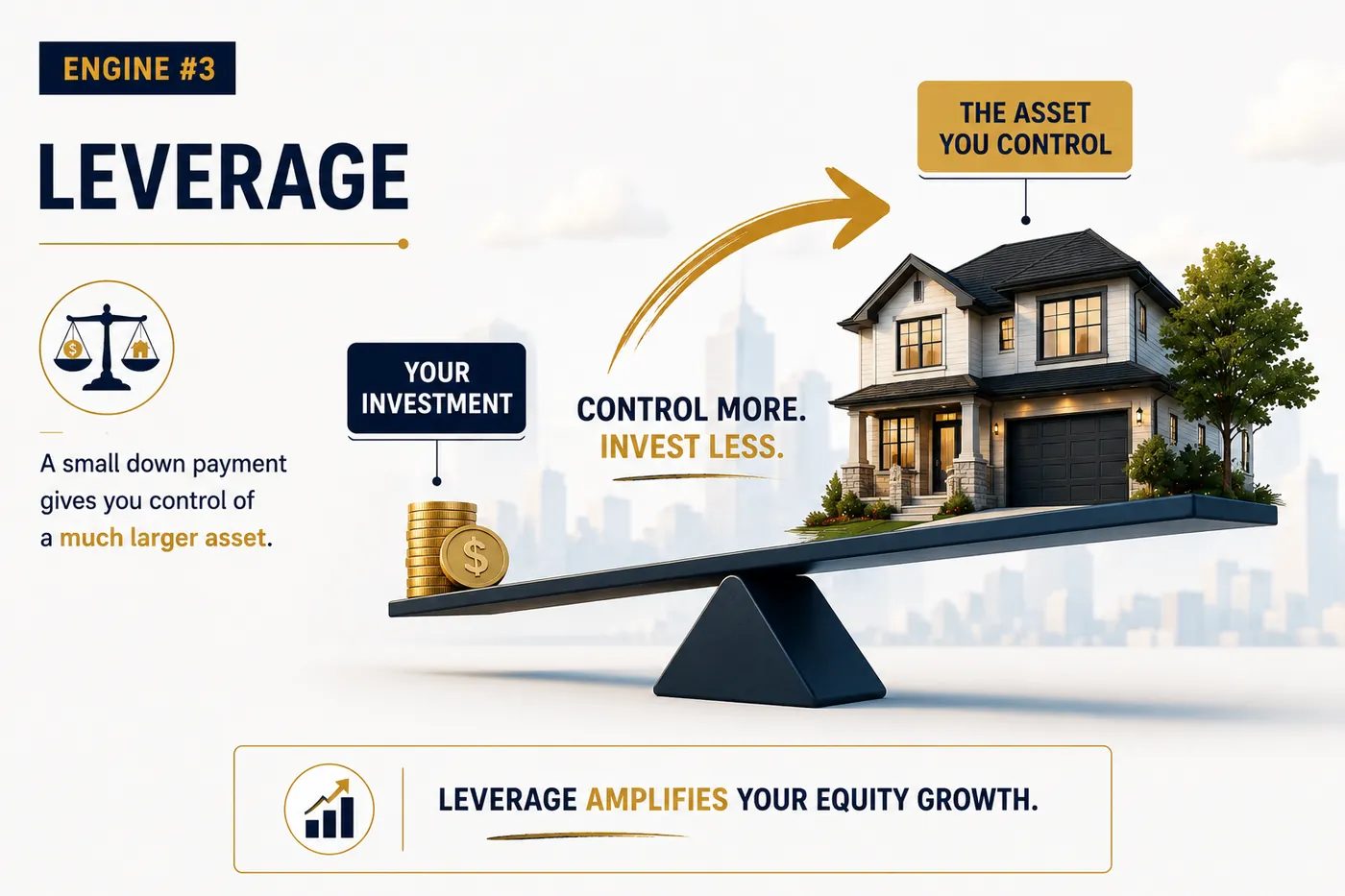
Unlike most investments, buying a home doesn't require you to invest the entire purchase price upfront. A relatively modest down payment allows you to control an asset that may be four or five times larger than the cash you've contributed. That's significant.
Because if the property's value increases, the appreciation is calculated on the value of the entire property—not just your down payment.
Continuing our example of purchasing an $800,000 home with a 20% down payment of $160,000.
If the property's value appreciates by 10%, it increases by $80,000.
You didn't invest $800,000. Yet your equity grows by the full $80,000, not just by 10% of your original down payment.
This ability to participate in the growth of a much larger asset is one of the reasons real estate has historically helped many families build meaningful wealth over the long term.
But leverage is a double-edged sword. Just as it can magnify gains, it can also magnify losses if property values decline or if borrowing stretches a family's finances beyond what is comfortable. That's why I firmly believe and advocate that affordability should never be based solely on what a lender is willing to approve. A lender evaluates whether you can make the payments.
Only you can determine whether those payments allow you to maintain your lifestyle, achieve your other financial goals, and sleep peacefully at night.
The most successful homeowners I've worked with haven't necessarily borrowed the maximum available to them. They've borrowed responsibly. They've left room for life's unexpected events. And they've allowed leverage to become a wealth-building tool rather than a source of financial pressure.
Leverage is powerful only when combined with sound financial discipline.
Engine #4: Time and Compounding
If appreciation is the most visible wealth engine, time is the force that quietly allows all the others to reach their full potential.
Think of it like planting a fruit tree. The day you plant the seed, there is little to see. It doesn't provide shade, bear fruit, or reveal its true potential. Yet beneath the surface, growth has already begun. With careful planning, consistent care, and, most importantly, time, that small seed gradually develops into a tree capable of producing an abundant harvest for many years.
Real estate often works the same way. The benefits of appreciation, principal paydown, and responsible leverage don't usually transform a family's financial future overnight. They build gradually, reinforcing one another year after year until the cumulative impact becomes remarkable.
This is why I believe time is the most underestimated wealth engine.
Many people associate compounding only with stocks or investment portfolios. But compounding exists in homeownership as well. It simply takes a different form—one that's quieter, less visible, but equally powerful over the long term.
Time is the factor which allows each of the previous three wealth engines to continue working simultaneously.
Every year you own your home:
Your mortgage balance becomes smaller.
Your ownership stake becomes larger.
Your property may appreciate in value.
Future appreciation is earned on an increasingly valuable asset.
Your growing equity provides opportunities that may not have existed a few years earlier, whether that's refinancing, investing, or simply having greater financial security.
Together, they become remarkably powerful. That's the beauty of compounding. It doesn't happen overnight and it rarely feels dramatic.
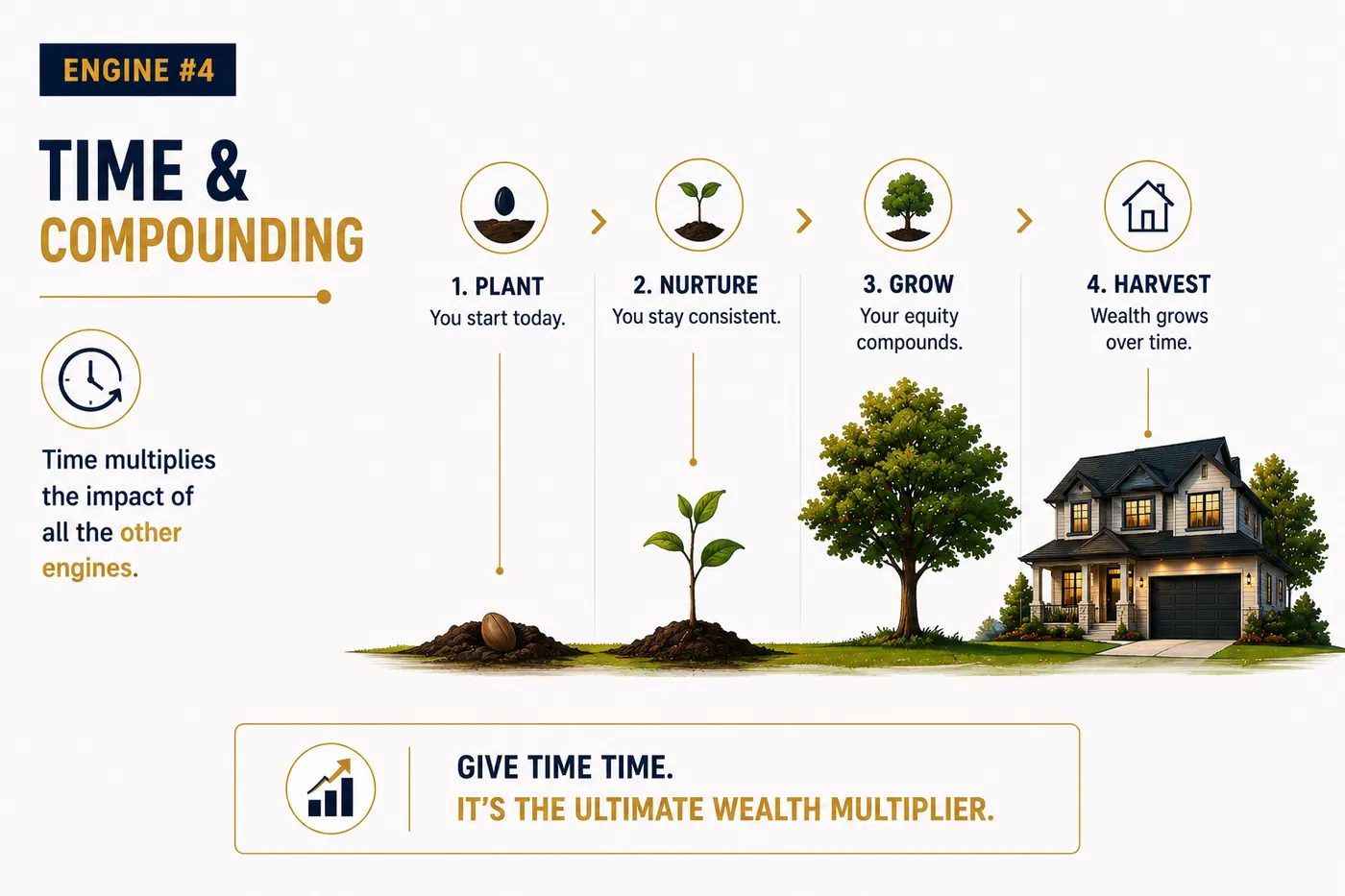
In fact, most homeowners don't notice it while it's happening. Then one day they look back after ten or fifteen years and realize how much their financial position has changed—not because of one extraordinary event, but because of hundreds of ordinary ones working together.
This is why we can safely say that time isn't just another engine—it is the force that allows the other three engines to reach their full potential.
The longer a property is owned responsibly, the more opportunity these engines have to reinforce one another.
"Time is the only wealth engine that money alone cannot buy. Every homeowner has to earn it."
Real estate has rarely been about getting rich quickly. It has been about giving these four wealth engines enough time to do what they were designed to do.
The Better Question
Whenever uncertainty increases, buyers often ask:
"Is this the right time to buy?"
It's an understandable question. No one wants to make an expensive financial mistake. But after watching buyers, sellers, and investors navigate multiple market cycles over the years, I've come to believe there is a more important question.
Instead of asking,
"Can I buy at the perfect time?"
Ask yourself,
"Can I comfortably own this property long enough for the four wealth engines to work in my favour?"
Because that's where the conversation changes. Markets will always move in cycles. Interest rates will rise and fall. Headlines will alternate between optimism and uncertainty. No one can consistently predict what the market will do next year.
But what history has repeatedly shown is that wealth has often been created by people who bought responsibly, remained financially disciplined, and gave time the opportunity to do its work.
The Bigger Picture
Too often, we judge the success of homeownership by asking only one question:
"How much did the property's value increase?"
A homeowner who purchased responsibly five or ten years ago didn't build wealth through appreciation alone.
They also benefited from:
Thousands of dollars of mortgage principal being paid down.
Responsible use of leverage.
Years of compounding quietly reinforcing every other wealth engine.
Buying a home should always be based on affordability, financial readiness, and your personal goals. But if those foundations are in place, it's worth remembering something that many people overlook.
Homeownership doesn't rely on one wealth engine.
It relies on four. Appreciation, Principal Paydown, Leverage, and Time.
Individually, each engine contributes to building wealth. Together, they can create outcomes that are far greater than the sum of their parts.
Perhaps that's why some families quietly build significant wealth over decades—not because they perfectly timed the market, but because they gave these four wealth engines enough time to work together.
Every family's real estate journey is different. The right strategy depends on your goals, financial position, time horizon, and comfort with risk—not someone else's.
If you're thinking about your next move, whether that's buying your first home, upgrading, downsizing, or reviewing your investment portfolio, I'd be happy to have a conversation.
Sometimes the greatest value comes not from rushing into the next transaction, but from taking the time to build the right long-term strategy.